



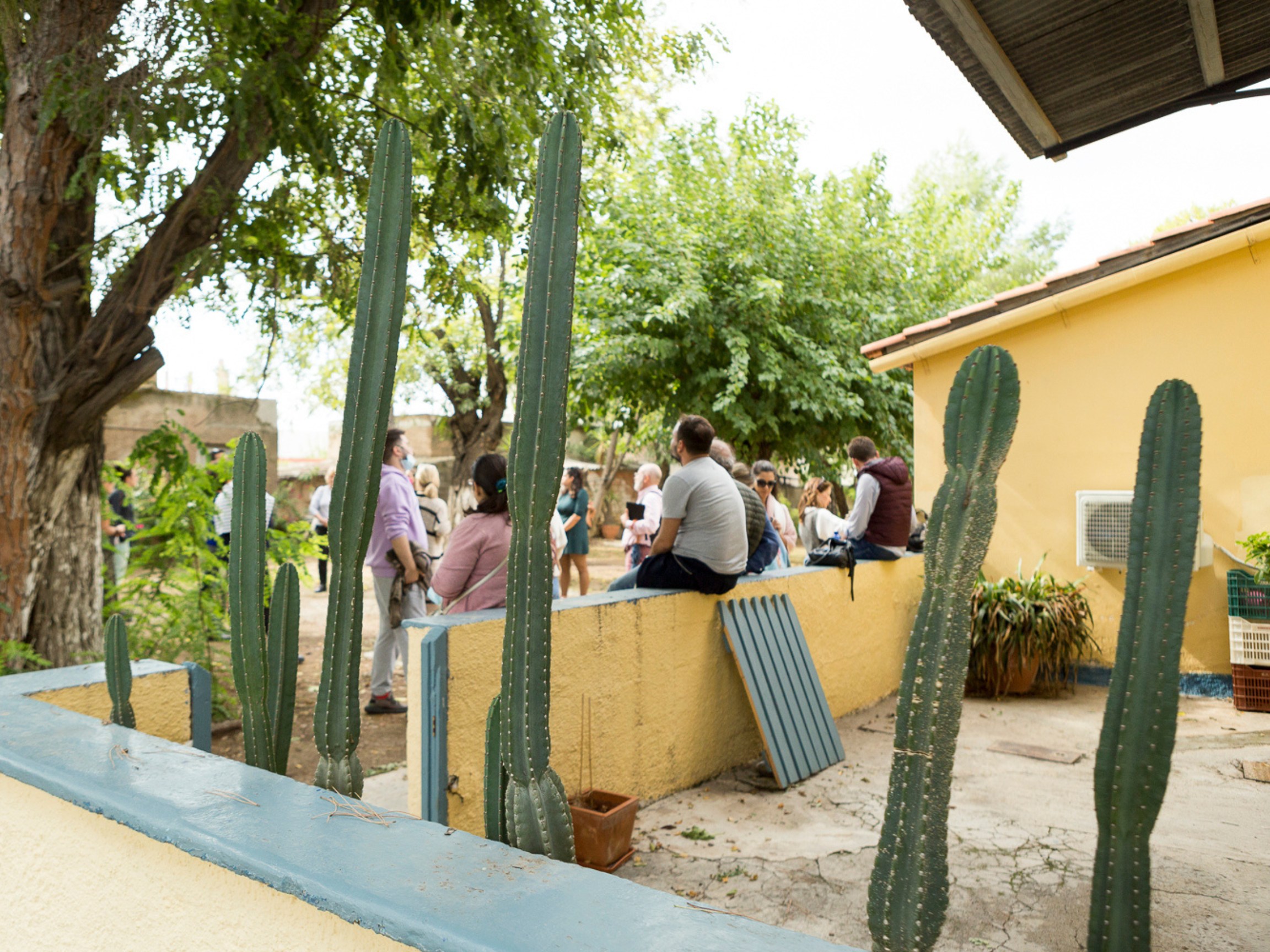
In a time when cities, neighbourhoods, local communities and cultural organisations are called upon to redefine their role, the New European Bauhaus (NEB) comes to propose a new framework of thinking and action. Not only for architecture or urban design, but for the way in which we perceive spaces, relationships, the cultural experience and collective life.
The European Commission describes the NEB as a political and funding initiative that connects the green transition with more attractive, inclusive and sustainable spaces and ways of life. At its core are three words: beautiful, sustainable, together.
For cultural organisations, this triad is much more than a European slogan. It is an invitation to rethink culture as a field of transformation: of places, communities, everyday experience and the relationship of people with their past, present and future.
Within the framework of the NEB, beauty is not limited to the image of a space or the aesthetic value of an object. It concerns the quality of the experience. The way in which a person feels when entering a museum, participating in a cultural action, walking through a neighbourhood or discovering a story of their place.
For a cultural organisation, this means that beauty can be found in narration, care, accessibility, clarity, atmosphere, the connection with memory and identity. A cultural project is not “beautiful” only when it is aesthetically pleasing. It is beautiful when it creates meaning, when it activates emotions, when it makes the visitor or participant feel that they belong to something broader.
Sustainability in culture does not concern only the reduction of the environmental footprint of an action, although this is now necessary. It also concerns duration, continuity and the real usefulness and value of a project for the community.
A cultural programme can be sustainable when it is not exhausted in a single event, but leaves behind knowledge, relationships, material, methodology, networks and new possibilities. When it is connected with the needs of a place. When it uses its resources responsibly. When it creates collaborations that can evolve. When it gives people a reason to return, to participate, to continue.
At this point, the NEB opens a particularly interesting path for museums, municipalities, cultural organisations, creative groups and cultural heritage bodies. It calls on them to think not only about what they produce, but also about what they leave behind.
Many cultural organisations say that they are open to all. The question, however, is: who truly feels that what we offer concerns them?
Inclusion is not simply the existence of free entrance, a ramp or an educational program. It is the way in which different audience groups participate in the design, are recognised in the narrative, have access to information, feel that the experience has been designed for them as well.
The NEB Compass, the reference tool of the initiative, places particular emphasis both on the values of the NEB and on the way of working: participatory process, multi-level involvement and interdisciplinary approach.
For cultural organisations, this means moving beyond simply being “open to all” and ensuring that inclusion is embedded from the very beginning of the design process. It must inform audience research, shape the narrative, guide the selection of partners, define communication and dissemination channels, and be reflected in the way a project is evaluated.
The New European Bauhaus is often associated with architecture, public space and urban transformation. But its essence is deeply cultural. No transformation can succeed if it does not engage with the stories, memories, identities and needs of the people who live in a place.
This is exactly where cultural organisations have a critical role to play. They can function as bridges between policy, society, science, art, education and everyday life. They can translate major European priorities into experiences that become understandable, participatory and meaningful for the public.
A museum can reread its collection through the prism of sustainability. A municipality can activate a neighbourhood through participatory cultural actions. A cultural organisation can design a programme that connects local history with the environment, new technologies and the community. A cultural route can become a tool for education, tourism, social cohesion and local development.
The NEB does not simply ask for nice ideas. It asks for projects with a clear objective, participatory logic, sustainable design and meaningful impact. This is also the most difficult point for many organisations: how a general intention —“to do something for the community”, “to utilise a space”, “to connect heritage with the present”— is transformed into a complete, documented and implementable project.
This requires research, a strong narrative, and a clear mapping of audiences and stakeholders. It requires experience design, a communication strategy, production planning, and, often, a connection to European funding opportunities and networks.
The New European Bauhaus Facility 2025–2027 roadmap shows that the NEB is now moving into a more mature phase, with tools that support the development and scaling of innovative solutions for neighbourhoods and communities that are at the same time sustainable, inclusive and beautiful.
For MENTOR, the significance of the NEB lies precisely here: in the fact that it recognises culture not as a supporting element, but as a primary method of change. As a way of connecting people with their place. As a tool that can make European policies more understandable and closer to everyday life. As a field where research, creativity, communication, participation, and local development can come together.
Cultural organisations can approach the NEB as an opportunity to redefine their role: to build new partnerships, activate communities, design projects with longer-term value, and connect their cultural mission with the major challenges of our time.
Ultimately, the question raised by the NEB is not only how we can make our spaces more sustainable or more beautiful. It is how we can make our communities more vibrant, fairer, more participatory, and more deeply connected to the culture that shapes them.
The New European Bauhaus is much more than a European initiative. It is an opportunity for cultural organisations to reposition themselves as spaces of participation, connection, local development, and social transformation.
At MENTOR, we design and support cultural projects that do not remain at the level of theory. We transform ideas, needs, and European priorities into fully developed proposals, participatory actions, and experiences with meaningful impact for people and their places.
If your organisation is looking for a way to connect culture with sustainability, inclusion, community, and the funding opportunities offered by the NEB, we can design the next step together: from the conception of the idea and the shaping of the narrative, to proposal development, production, and project communication.
Because the cultural organisations of tomorrow will not simply be spaces of memory or presentation. They will be active agents of change. And this transition requires vision, strategy, and the right partners.